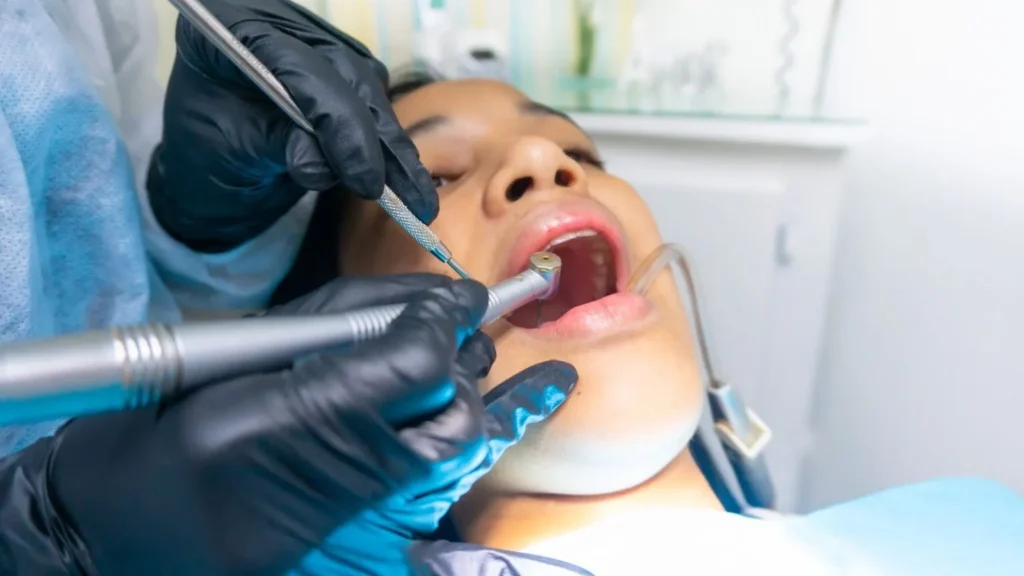
What Is a Dental Emergency?
A dental emergency is any situation involving your teeth, gums, or mouth that needs prompt attention, such as stopping bleeding, easing severe pain, or saving a tooth. These are not problems that can wait until your next appointment. Acting quickly can make all the difference for both your comfort and your long-term dental health.
Most of us have faced a dental dilemma at some point. Maybe you bit down on something hard and felt a sudden crack, or woke up in the night with a throbbing toothache that just wouldn’t let you sleep. These moments can feel scary and confusing, especially if you’re not sure what steps to take next.
That’s where this guide comes in. Here, you’ll find clear, calm steps to take if you’re facing a dental emergency, whether it’s a knocked-out tooth, a broken crown, or a painful abscess. My goal is to help you feel prepared and confident, even in a stressful moment.
Common Types of Dental Emergencies
Before you take action, it helps to know what really counts as a dental emergency. Not every dental problem needs urgent care, but some situations can’t wait. Here are some of the most common dental emergencies people experience:
- Knocked-out (avulsed) tooth: A tooth that has been completely knocked out of its socket.
- Cracked or fractured tooth: A tooth that is cracked or broken, sometimes revealing the inner pulp.
- Toothache: Pain that is more than normal, is severe, and is not relieved by over-the-counter pain medication.
- Dental abscess: A pus-filled infection around a tooth or in the gums, which may extend to the jaw or neck.
- Exposed tooth roots or missing fillings or dental crowns: If you have exposed tooth roots or a missing filling or dental crown, the root is exposed and sensitive.
- Bites of wires or brackets: Bites on soft tissues of the mouth from broken wires or braces
- Soft tissue injury: Cuts, lacerations, or tears in lips, cheeks, tongue, or gums
- Object stuck between teeth: An object that can’t be removed from between the teeth with floss.

If you recognize any of these situations, keep reading. This guide will walk you through what to do, step by step, for each scenario.
Step-by-Step Guide to Handling a Dental Emergency
The first few minutes after a dental emergency can make a big difference in what happens next. Here’s a simple overview of what to do right away, before we get into the details for each type of emergency:
Step 1: Stay Calm
Panic can make any situation feel worse. Take a deep breath. With prompt and proper care, most dental emergencies have a good outcome.
Step 2: Assess the Situation
Ask yourself:
- Am I, or is someone else really suffering a lot?
- Is there any serious bleeding?
- Is there a knocked-out or broken tooth?
- Does the face, neck, or jaw feel swollen?
Step 3: Call Your Dentist Immediately
Call your regular dentist first. Many offices have an emergency line you can reach after hours, or they can help you find an emergency dental clinic nearby. Be as clear as you can about your symptoms so they can guide you on what to do next.
Step 4: Apply Basic First Aid
Until you are attended to:
- Apply gauze or a clean cloth to stop bleeding.
- Apply a cold pack or ice wrapped in a cloth to help with swelling and pain.
- Take over-the-counter pain medicine like ibuprofen as directed, but avoid aspirin if there is any bleeding.
- Aspirin should NOT be placed directly on a tooth/gum as it may damage tissues.
Step 5: Get to a Dentist as Quickly as Possible
In a dental emergency, every minute counts. For example, a knocked-out tooth has the best chance of being saved if you can get to the dentist within an hour.
Knocked-Out Tooth: What to Do Right Away
A knocked-out tooth is one of the most serious and time-sensitive dental emergencies. The following are the steps you need to follow:
Immediate Steps:
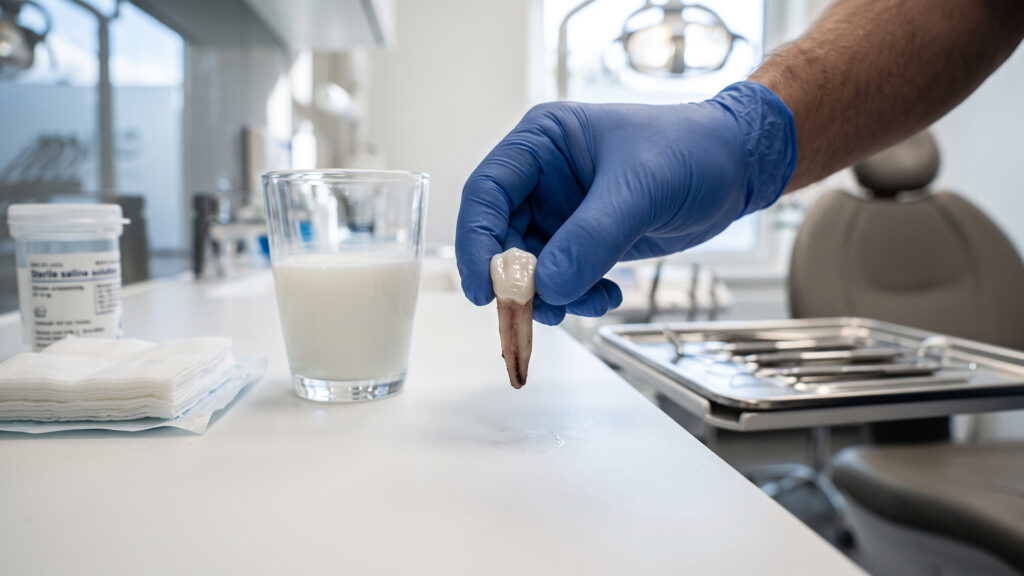
Grab the tooth at the top (the white part that we bite), not at the bottom (the root). Damage to the root from touching can destroy the cells necessary for reattachment.
2. If it is dirty, gently clean it with clean water. Do not scrub, dry, or wrap it in a tissue.
3. If possible, reinsert it in the socket. Gently push it in and bite down softly on a piece of gauze to hold it in place.
If it can’t be reinserted, place the tooth in one of the following:
- Whole milk (Best). A glass of this milk is best.
- Make saliva, hold it between the cheek and gum.
- A tooth preservation kit (such as Save-A-Tooth)
- As a last resort, use saline solution.
See a dentist ASAP (within 30 minutes). This is critical.
A knocked-out tooth should NOT be put in tap water. The chemicals in tap water may damage root cells and reduce the likelihood of successful reattachment.
Cracked or Chipped Tooth: How to Handle It
A chipped or cracked tooth isn’t always an emergency, especially if it doesn’t hurt. Still, even a small crack can get worse over time and may lead to infection or tooth loss if left untreated.
What to Do:
- Rinse mouth with warm water (to clean the area).
- If the tooth is broken, preserve the fragments if possible and take them to the dentist.
- If there is any bleeding, use gauze and apply gentle pressure for approximately 10 minutes.
- Apply a cold compress to the outside of your cheek to help reduce swelling and pain.
- Use dental wax or sugar-free gum to protect the inside of your cheek or tongue if there are any sharp edges.
- Don’t chew on that side of your mouth until you go to the dentist.
- Reach out to your dentist as soon as you can. Chewing or grinding can worsen a fractured tooth.
Treatment will depend on how serious the crack is. Sometimes a small chip needs a simple filling or bonding, while a deeper fracture might need a crown, root canal, or even extraction.
Severe Toothache: Steps to Manage the Pain
Toothaches are one of the most common reasons people need emergency dental care. If your pain is sharp, throbbing, or won’t go away—especially if it’s keeping you up at night—it could be a sign of something serious.
What to Do:
- Rinse mouth with warm salt water. This can help reduce inflammation and cleanse the area.
- Try gently flossing around the sore tooth to determine whether the pain is caused by food or debris.
- Follow the label instructions when taking over-the-counter pain relievers, such as acetaminophen (Tylenol) or ibuprofen (Advil).
- Use a cotton ball to apply a small amount of clove oil to the affected area. Eugenol is a natural anesthetic in clove oil.
- Try not to eat very hot or very cold foods or sweets, as they may cause or aggravate pain.
- Call your dentist. Toothaches rarely go away on their own and are often a sign of a cavity, infection, or abscess that needs professional care.
Do not place aspirin on your gum or tooth. This old-fashioned remedy may actually burn the gum tissue and cause further harm.
Lost Filling or Crown: Quick Fixes Until You See a Dentist
If you lose a filling or crown, your tooth may become sensitive and be at greater risk of further damage. While it’s not usually life-threatening, it’s still important to have it checked and repaired soon.
What to Do If You Lose a Filling:
Temporarily fill the cavity with dental cement (available at most pharmacies) until your appointment.
Sugar-free gum is another short-term substitution, but not regular gum, as this may cause tooth sensitivity.
Try not to chew on that side of your mouth.
What to Do If You Lose a Crown:
- Try to find the crown and bring it to your appointment.
- Gently clean and dry the crown.
- Re-cement the crown with dental cement or toothpaste until ready to be permanently cemented. Dental cement kits are available at some pharmacies for this purpose.
- Never use super glue, as it can be toxic and may damage your tooth or crown.
- If your tooth is exposed and painful, call your dentist’s office as soon as possible.
Dental Abscess: Why You Should Not Wait
A dental abscess is an infection around the root of a tooth or in the gums. If it spreads to your jaw, neck, or beyond, it can become very serious. This is one dental emergency you should never delay treating.
Signs of a Dental Abscess:
- A very bad, long-lasting, very strong toothache.
- Radiating pain to your jaw, neck, or ear
- Sensitivity to hot and cold temperatures
- Swelling in your face or cheek
- Swollen, painful lymph nodes under your jaw or in your neck
- Fever
- A bump that looks like a pimple on your gum that can ooze pus
What to Do:
- See your dentist as soon as possible and let them know about your symptoms. If you think you have an abscess, let someone close to you know as well.
- Use a saltwater rinse several times throughout the day to help draw out the pus and minimize discomfort.
- You can bring over-the-counter pain medicine to help manage discomfort while you wait for your appointment.
- Seek immediate medical attention at an emergency room if you cannot breathe or swallow, or if the swelling is very severe on your face. These are the symptoms that the infection could be spreading.
A dental abscess typically requires drainage of the infection, antibiotics, a root canal, or extraction to treat the underlying cause.
Soft Tissue Injuries in the Mouth
The mouth has many blood vessels, so injuries to your lips, tongue, cheeks, or gums can bleed quite a bit. While many of these injuries can be managed at home at first, they can still feel alarming.
What to Do:
- Gently rinse mouth with a saline solution.
- Press a dry cloth or gauze directly over the bleeding area for 15-20 minutes.
- Apply a cold compress to the outside of your face to decrease the swelling.
- Seek medical attention if bleeding persists after 20 minutes or if the wound is deep.
- Don’t wait to check in with your dentist; they can make sure there’s no damage to your teeth or jaw beneath the surface.
What to Keep in a Dental Emergency Kit
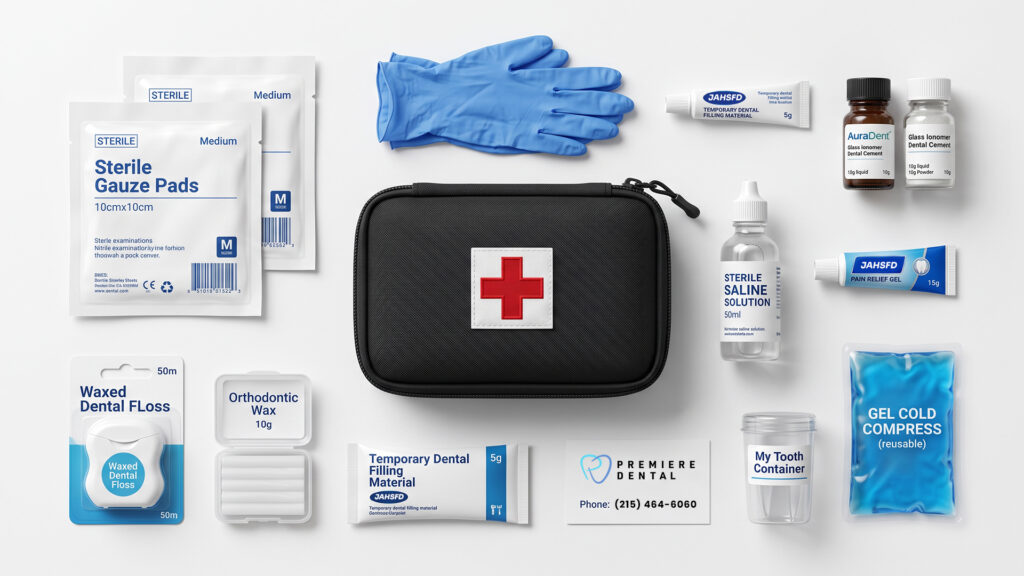
Being prepared can make a dental emergency much less stressful. Consider putting together a simple dental emergency kit to keep at home, in your car, or in your child’s sports bag.
Items to Include:
- Dental cement or temporary filling material (from a pharmacy)
- A bandage for stopping the bleeding.
- Small bag for a knocked-out tooth. Small bag with a lid for a knocked-out tooth.
- A solution of salt and water or salt packets.
- Nonprescription pain medication (ibuprofen or acetaminophen)
- Clove oil can be a helpful natural option for easing dental pain.
- Dental wax to cover sharp edges from broken teeth and/or braces.
- Your dentist’s emergency phone number
- Tweezers (for picking up any objects that are stuck but can be seen)
- A small flashlight to illuminate the mouth
You can also find ready-made dental emergency kits at most pharmacies or online. Having one on hand can save you time and help you stay calm in an emergency.
When to Go to the Emergency Room vs. a Dentist
Not every dental emergency means a trip to the ER, but some do. Here’s a quick guide to help you decide where to go:
Go to the Emergency Room If:
- Swelling makes it hard to breathe or swallow
- Your face or jaw is swollen badly and has suddenly appeared
- You have a broken or dislocated jaw.
- You have uncontrolled bleeding that won’t stop after 20 minutes of pressure
- Signs of infection are spreading, the fever is high, the neck glands are enlarged, and the mouth is hard to open.
Call Your Dentist or Visit an Emergency Dentist If:
- A tooth has been knocked out
- You have a severe toothache
- You have a broken, chipped, or cracked tooth
- A crown or filling has fallen out. A crown or filling is missing.
- You have a dental abscess (but not the above ER-level symptoms)
- Either a brace or a wire is broken, and you are in pain.
There are also emergency dental offices in many areas that are open in the evenings and on weekends. Using the internet to search for ’emergency dentist near me’ is one of the best ways to reach a dentist’s office in a dental emergency.
How to Find Emergency Dental Care Near You
If you don’t have a regular dentist or they’re unavailable, here are some tips to help you find emergency dental care quickly.
- Visit online: Search Google for “emergency dentist near me” or “24-hour dental clinic”.
- Dial 211: In the United States, 211 will help you find community services, including dental emergency services.
- Use the American Dental Association’s Find-a-Dentist tool to locate dentists in your area and the types of dentistry they practice.
- Go to a dental school: Many dental schools have an emergency clinic that may be less expensive.
- Call your insurance company: They should be able to provide you with a list of in-network emergency dentists in your area.
- Check with your pharmacist, as they may be able to direct you to a local dental clinic or urgent care center that can provide basic emergency dental care.
How to Prevent Dental Emergencies
While you can’t predict every dental emergency, many can be prevented with good oral care and a few simple precautions.
Tips to Reduce Your Risk:
- Use a mouthguard when playing contact sports or any activity where you might be at risk of injury to your face.
- Do not use teeth as tools, do not open packages, bite nails, or chew pens or ice.
- See your dentist every six months for routine checkups. These visits help catch small problems, such as cavities or cracks, before they turn into emergencies.
- If you grind your teeth (bruxism), wear a night guard. Grinding can put tremendous pressure on teeth and may lead to cracks or fractures over time.
- Practice proper oral hygiene, brush teeth twice daily, floss once daily, and use fluoride toothpaste to strengthen and maintain healthy teeth.
- Refrain from extremely hard foods, such as hard candy, popcorn kernels, and unpopped corn, as these may crack the teeth.
- Take care of dental problems early. If you notice a toothache, sensitivity, or even a small crack, don’t wait—schedule an appointment soon.
The best way to protect yourself from dental emergencies is with regular dental care. If it’s been a while since your last visit, now is a great time to schedule a checkup.
Conclusion
Dental emergencies can happen to anyone, anytime. Knowing what to do in those first important moments can make all the difference, sometimes even saving a tooth or preventing a bigger problem. With a clear plan, you’ll be ready to stay calm, act quickly, and get the care you need.
Whether you’re dealing with a knocked-out tooth, a cracked crown, a toothache, or a dental abscess, the steps are similar: stay calm, assess what’s happening, call your dentist, take basic first aid measures, and get professional help as soon as you can.
A quick review of what you’ve learned so far:
- Understand what constitutes a dental emergency.
- Follow each of the steps for each type of dental emergency
- Have a dental emergency kit at home and to travel with
- Know when to visit a dentist vs. the emergency room
- Preventive measures to reduce the likelihood of future dental emergencies.
Don’t wait for a dental emergency to find out what to do. Save your dentist’s emergency number in your phone, put together a simple dental emergency kit, and share this information with your family so everyone feels prepared if the unexpected happens.
Frequently Asked Questions
Q: What counts as a dental emergency?
A: Any dental condition that results in a tooth being knocked out, pain, significant bleeding, or swelling is a dental emergency. Fever and facial swelling are also emergency conditions requiring immediate treatment.
Q: Can I go to urgent care for a dental emergency?
A: Urgent care centers can help with your pain or infection (antibiotics), but they cannot give you a dental procedure. If a person really needs dental treatment, they must see a dentist or an emergency dental clinic.
Q: What should I do if my child knocks out a baby tooth?
A: Avoid reinsertion of a knocked-out baby tooth, as this may damage the permanent tooth beneath. Get immediate advice from your child’s dentist.
Q: Is a broken tooth always an emergency?
A: It depends on the severity. If the small crack isn’t causing pain, it’s okay to wait a day or two. But if the tooth is severely cracked, painful, or has exposed inner pulp, seek emergency dental care immediately.
Q: How do I know if I have a dental abscess?
A: Symptoms may include extreme pain in the tooth, a pus-filled bump on the gum, a foul taste in the mouth, fever, and severe gum swelling, which can sometimes be seen. If you think you may have an abscess, see the dentist right away.
Q: Can a knocked-out tooth really be saved?
A: Yes, but if you’re quick. If the permanent tooth is knocked out, it can be saved if it is brought to the dentist within 30-60 minutes and is properly stored on the way.
Q: What’s the fastest way to relieve dental pain at home?
A: Some pain relievers can be bought without a prescription, such as ibuprofen, warm salt water rinses, and clove oil applied to the affected area, which can help calm pain temporarily. But these are not substitutes for professional dental care.