
Picture this. You’re at a family dinner, and you quietly push the corn on the cob aside because your loose denture can’t handle it. Someone leans over and says, “Have you ever thought about implants?” You laugh it off. “At my age? Please.”
If that sounds familiar, you’re far from alone. Plenty of adults in their 50s, 60s, 70s, and even 80s assume the window for a dental implant closed years ago. They think it’s for younger people with healthier mouths and more years ahead.
Here’s the thing, though. That assumption is one of dentistry’s most common myths, and it keeps many people eating soft foods and hiding their smiles for no good reason. So let’s walk through what actually decides whether a dental implant is right for you.
First, a quick refresher on what a dental implant actually is
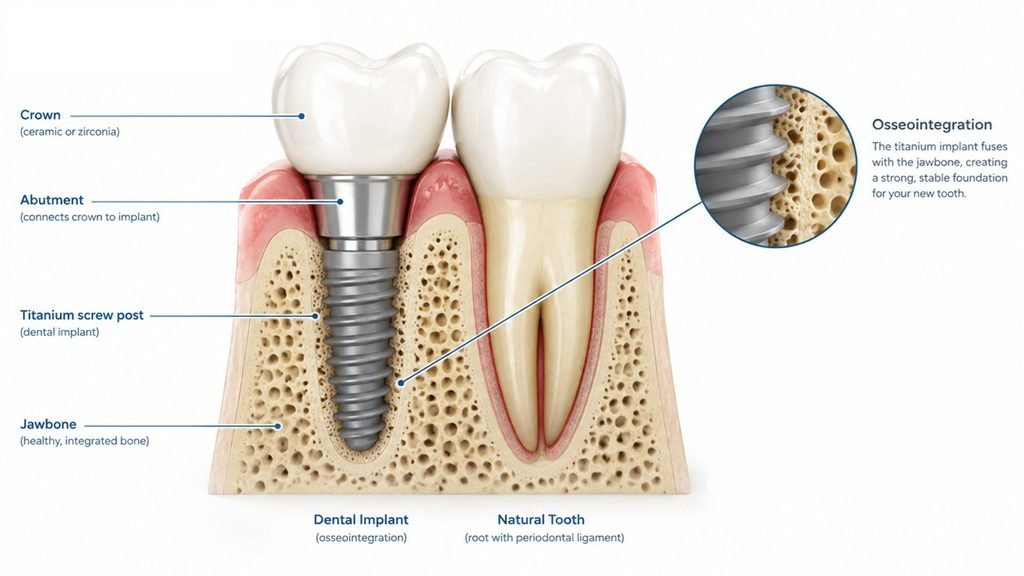
A dental implant is a small post, usually made of titanium, that’s placed into your jawbone where a tooth used to be. Over a few months, the bone grows around it and holds it firmly in place. Once it’s stable, a custom crown, bridge, or denture is attached.
Think of it as rebuilding a tooth from the root up. A bridge or regular denture replaces only the part you can see. A dental implant replaces the root too, which is why it feels and functions so much like a natural tooth.
That root is also the reason implants have such a strong reputation. When you bite down, the force travels into your jawbone, helping keep it active and healthy. Nothing else on the market does that quite the same way.
So, is there an age limit for dental implants?
Short answer: no.
There’s no upper age limit for dental implants, and dentists don’t use a certain birthday as a cutoff. Adults in their 70s and 80s receive implants all the time and do very well. The only real age-related rule is on the younger side. Dentists generally don’t place implants until a person’s jaw has finished growing, usually in the late teens or early twenties.
Dentists care more about biological age than the number on your driver’s license. Two 72-year-olds can have completely different mouths and completely different health. One might walk three miles a day, manage their blood pressure well, and have solid jawbone. The other might have several uncontrolled health issues and advanced gum disease. Same age, very different candidates.
That’s why a good dentist won’t say, “You’re too old,” after a quick glance at your chart. They’ll want to look at the whole picture first.
What actually matters more than your age
If age isn’t the deciding factor, what is? Here’s what your dentist will really be paying attention to.
1. The health of your gums
Healthy gums are the foundation of a successful dental implant. If you have active gum disease, you need to treat it first, because the infection can spread around an implant and cause it to fail. The good news is that gum disease is highly treatable, and many people go on to get implants after they’ve cleared it up.
2. The amount and quality of your jawbone
When a tooth is missing for a long time, the bone underneath slowly shrinks because it’s no longer being stimulated. This is common in people who have worn dentures for years. Your dentist will usually take a 3D scan to measure how much bone you have and how dense it is.
Now, if your bone has thinned out, that doesn’t automatically close the door. We’ll get to that in a moment.
3. Your overall health
Most chronic conditions don’t stop you from getting a dental implant, as long as they’re well managed. Conditions like diabetes, high blood pressure, and heart conditions are very common in older adults, and many people with them get implants successfully. What matters is control. Someone with stable blood sugar is in a much better position than someone whose levels swing wildly.
Some conditions and treatments do need extra care or coordination with your doctor. These include certain osteoporosis medications, radiation therapy to the head and neck, and conditions that weaken the immune system. That doesn’t always mean “no,” but it does mean your dentist and your physician should talk first.
4. Your habits
Smoking is the big one. It slows healing and raises the risk of implant failure, which is why most dentists strongly encourage cutting back or quitting before and after the procedure. Good daily oral hygiene matters too, since implants need care just like natural teeth do.
5. Your commitment to follow-up care
A dental implant isn’t a “set it and forget it” thing. Regular checkups and cleanings keep the surrounding tissue healthy. If you show up to your appointments, you’re already ahead of the game.
“But my jawbone has shrunk. Am I out of luck?”
Not necessarily, and this is where many people get discouraged too early.
If your bone is too thin or soft to hold an implant right now, you can build it back up. A bone graft adds bone material to the area, giving your jaw something solid to work with. If the upper jaw is the issue, a sinus lift can create more room for an implant near the back teeth. These procedures sound intimidating, but they’re routine in implant dentistry, and they often make the difference between “not a candidate” and “perfect candidate.”
There are also options designed for people with limited bone. Shorter implants, narrower implants, and full-arch solutions that use just a handful of strategically placed implants to support an entire row of teeth can all work in the right situation. Your dentist can tell you which approach fits your mouth after a proper exam and scan.
The takeaway? Bone loss is a hurdle, but it’s rarely a dead end.
What about healing? Does it take longer when you’re older?
This is a fair question, and an honest answer is: sometimes a little, but not always.
As we get older, the body can take a bit longer to heal. That’s just biology. But research and clinical experience show that older adults still have high implant success rates, generally above 90 percent, which is comparable to younger patients. Many dentists build in a little extra healing time and monitor you closely.
Most people are surprised by how manageable the process is. Local anesthesia keeps you comfortable during the procedure, and the discomfort afterward is usually described as mild to moderate, often controlled with over-the-counter pain relief. Sedation options are available too if you’re nervous. Many patients return to their normal routine within a few days, with a soft-food diet while the area settles.
Dental implants vs. dentures vs. bridges: how do they compare?
If you’re weighing your options, here’s a plain-language look at how they stack up.
Dentures are the most affordable upfront, but they sit on top of your gums rather than anchoring into bone. That means they can slip, click, and rub. Over time, the jawbone under them shrinks, so you may need adjustments or replacement as your mouth changes. Many people avoid certain foods or feel self-conscious talking and laughing in public.
Bridges use the teeth on either side of the gap as anchors. They can look great and are a faster fix than implants, but you need to file down the neighboring teeth to support the bridge. If one of those anchor teeth has a problem down the road, the whole bridge is affected.
A dental implant stands on its own. It doesn’t rely on neighboring teeth, it doesn’t slip, and it helps preserve your bone. The upfront cost is higher, but implants are designed to last for decades with good care, so many people find they’re better value over the long run. Dentures and bridges often need replacement or repair every few years.
None of these is “wrong,” and the best choice depends on your health, your budget, and what you want from your smile. But if the only reason you’ve ruled out implants is your age, it’s worth having another conversation.
The benefits go beyond just chewing
Ask someone who’s had a dental implant placed what changed, and they’ll rarely start with the technical stuff. They’ll tell you about the small things.
They’ll tell you they ordered the steak at a restaurant for the first time in years. That they stopped worrying about adhesive mid-conversation. That they smiled in a photo without thinking about it first.
There’s real health value here too. Being able to chew properly means you can eat a wider range of nutritious foods like fresh vegetables, nuts, and lean meats, instead of defaulting to whatever’s soft. Better nutrition supports your energy, immune system, and overall wellbeing, and that matters more with each passing year.
Then there’s confidence. Missing teeth can quietly chip away at how you feel about socializing, speaking up at work, or being photographed with grandkids. Restoring your smile can bring back a part of yourself you didn’t realize you’d tucked away.
What to expect at your first consultation
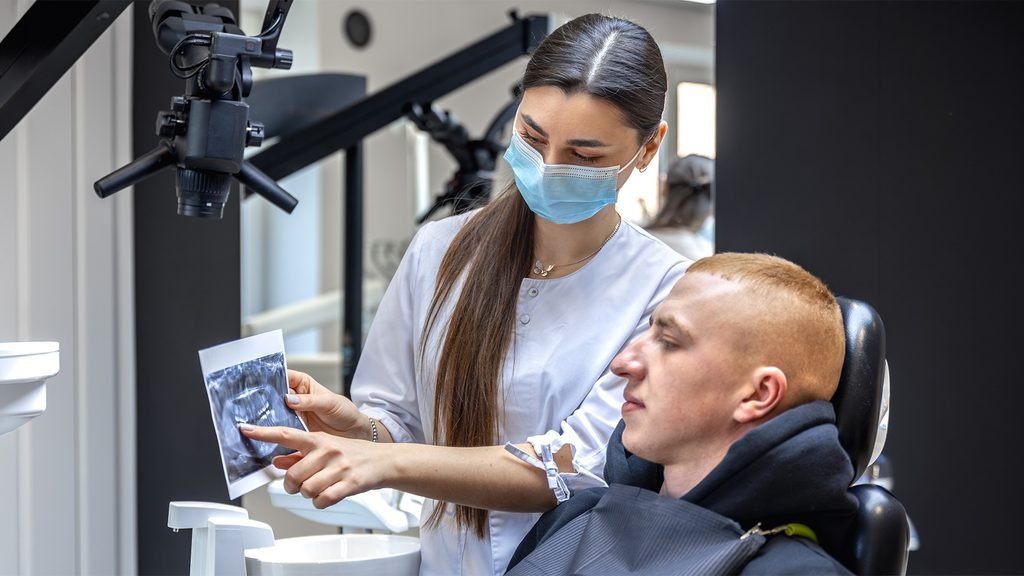
If you’re curious but nervous, the first step is simply a conversation.
At a consultation, your dentist will go through your medical history, including your medications and any conditions you’re managing. They’ll examine your teeth and gums, and take X-rays or a 3D scan to assess your jawbone. From there, they’ll tell you honestly whether you’re ready for a dental implant, whether you need some preparation first, or whether another option might suit you better.
You’re not committing to anything by asking. You’re just getting real information about your own mouth instead of relying on a myth you heard years ago.
It also helps to bring a short list of questions. Ask about the timeline, total cost, available financing or payment plans, and what recovery will look like for your situation. A good dental team will be glad to walk you through it without any pressure.
So, are you too old for a dental implant?
Almost certainly not.
Age is just one small part of a much bigger picture. What really matters is your gum health, jawbone strength, how well you manage your overall health, and your willingness to care for your new teeth. If you can tick those boxes, or work on them, a dental implant may be a real possibility, whether you’re 55, 75, or 85.
The most important step is the first one: finding out for sure. Not from a guess, a friend’s opinion, or something you read years ago, but from an actual exam with a dentist who takes the time to explain your options.
If you’ve been living with missing teeth, loose dentures, or a smile you’ve stopped showing, the team at Premiere Dental would love to help you find out where you stand. Book a consultation today to take the first step toward eating, speaking, and smiling the way you want.